



Using light blocking curtains in your home can help to reduce light in a room, create privacy in living rooms, reduce cold coming through windows in the winter months and reduce extreme heat in south Facing Rooms
In the summer. However, the meaning of light blocking is very varied between shops as it can be used for lightly lined curtains as well as heavily multi-layered ones.
This guide explains everything you need to know. We have covered reducing light, creating a better sleeping environment, reducing heat/energy usage and increasing privacy and reducing noise. We have also included realistic capabilities of different types of curtains, limitations and tips to ensure that you aren’t spending money on unnecessary features.
What Can Light Blocking Curtains Do?
Although the term ‘light blocking’ is used to describe a variety of products, all light blocking curtains have either a heavy material or lining to block light passing through. The exact capabilities of the curtain depend on how much of a heavy material, how many layers and how well it fits the window.
4 things light blocking curtains can help with:
- Reduce light and glare so rooms stay comfortable in every season
- Help you sleep by making the bedroom properly dark
- Manage heat and energy usage in cold winters and hot summers
- Increase privacy and reduce noice without turning the room into a cave
Depending on what you want the curtains to achieve in your room, certain features may be required. Depending on your requirements, a great choice for a nursery may not provide the same benefits in a sunlit home office. Decide what is most important in your room and for a broader overview of fabrics, styles and measuring first, start with the CurtainsX curtain buying guide.

Controlling Natural Light and Glare With Light Blocking Curtains
If natural light is causing glare on your screen, or waking you up in the early hours, it may be best to consider using light blocking curtains. It depends on how dark you want and how well the curtains fit.
Blackout, Room-Darkening and Light-Filtering: What Is the Difference?
These three labels describe how much daylight gets through, and they sit on a scale.
Light filtering – Linen-type weaves or sheer materials will help to reduce glare from natural light. However, very little privacy is created at night. Room darkening materials will be made from heavier weaves with a lining to significantly reduce light. This should allow for comfortable naps or watching TV. However, you will still likely notice some light around the edges of the curtains. Blackout material contains a thick backing or coating to allow almost no light to pass through.
Brands quote different percentages for each category. As a general guide, consider how the material is made. If you are trying to decide between blackout and room darkening curtains, simply ask yourself if you want a completely dark room, or just a calm environment.
Are Blackout Curtains Completely Light-proof?
Unfortunately not. While blackout curtains will reduce almost all light, some can still pass through. Light can enter between the top of the curtain and the curtain pole, from the sides of the curtains, and from the bottom hem and the join in the middle of two panelling.
Therefore, whether blackout curtains are light proof depends more on how well the curtains fit the window. A very well made blackout curtain with a small, narrow pole will still be letting in some light. However, a reasonably well made blackout curtain with a wide and tall pole will perform very well.
How to Close the Gaps
Making slight adjustments will help to prevent light getting in:
- Mount the rod higher than the window frame and let it extend about 4 to 8 inches (10 to 20 cm) past each side.
- Use curtains around 1.5-2x the width of the pole to allow for overlap.
- Allow the curtains to just reach the floor (or slightly longer for a better seal).
- Ensure that there is overlap in the centre of the panelling. Alternatively, use a small clip/magnet.
- For persistent light issues, try adding a circular pole to the curtains, or adding a valance to the top of the pole. Alternatively, adding velcro strips to the sides.
With a few simple alterations, you should be able to prevent light from leaking from your curtains. If you need help with sizing, the CurtainsX how to measure guide walks you through width, drop and fullness.
Avoiding Glare and Fading in South Facing Rooms
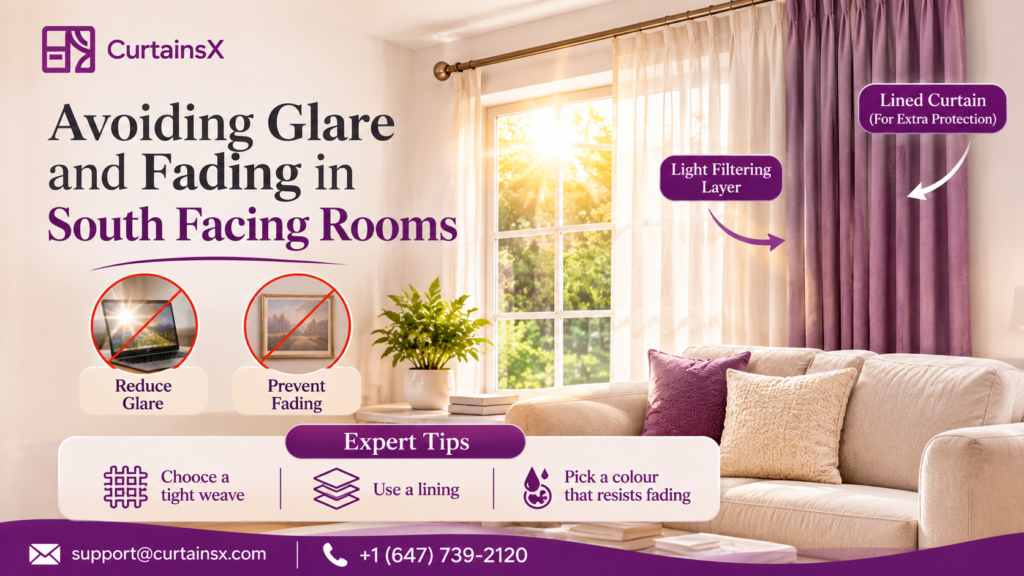
In the northern hemisphere, south facing windows get the most and the strongest sunlight. This can cause glare in front of screens and can cause fading in furnishings, flooring and art in the room.
To avoid this issue, it is best to have multiple layers in your curtains. Having a light filtering layer means that there will be sufficient light in the room with less harsh glare on your furniture. Once the sun is at its peak, you can draw a lined curtain over the top of the light filtering one. The lining in the curtain will also help to protect the curtain itself, as it will take the brunt of the sun.
If you have south facing windows in your home, choose curtains with a tight weave, and lining. Choose a colour which won’t show fading lines over time. If you are unsure which lining to go for, see our buying guide for information on standard, blackout and thermal linings.
Optimizing Your Bedroom for Sleep
Creating a dark environment in your bedroom is an excellent and cheap way to improve your sleep. As light can trick your brain into staying alert, and melatonin (a hormone in your body that helps to tell you to get to sleep) is produced in darker environments, having light in your bedroom can make it harder to sleep. According to Cleveland Clinic, light in the bedroom can affect sleep even when your eyes are closed, and one 2016 study found that people with more light exposure during sleep got about ten minutes less rest per night.
Another study from Northwestern University found similar results. 20 young people were studied, and after one night in a moderately lit room (around 100 lux, brighter than a typical night-light), participants showed increased heart rates and signs of increased insulin resistance. Although these studies are small, and curtains certainly won’t solve all sleeping issues, there is a clear pattern. Blackout curtains therefore help improve sleep by removing light that your body is reacting to.
To get the best effect from a dark room:
- Cover any little lights emitted from devices and charging devices.
- Dim lamps in your room an hour before bed.
- Ensure there are no gaps in the curtains using the tips above.
- Pull the curtains back in the morning. Light in the morning can help regulate your body clock.
- Wear a sleep mask if a little light is still entering.
If you still sleep badly in a properly dark room, talk to a doctor. Curtains help with light, not with every cause of poor sleep.
Night-Shift Workers and Day Sleepers
It can be very difficult for shift workers to get a good amount of sleep. To have blackout curtains for sleeping during the day, it is most important to consider blackout material, having a wide and tall pole and overlapping panelling in the middle.
A great tip is to have a blackout liner behind a decorative curtain. This means the room will be dark for you, but the room will still appear normal to the rest of the house. If you want a soft, linen-style look with blackout function, take a look at the linen-touch blackout curtains at CurtainsX. Daytime noise can be just as disruptive as light, so read the noise section below before you set expectations.
Insulation, Heat and Energy Efficiency
Windows are usually the weakest link in a home’s insulation. Natural Resources Canada says window coverings can reduce energy loss, lower heating and cooling bills and improve comfort. The U.S. Department of Energy states that depending on what type of covering you use, what time of year it is, what climate you live in and how you use your curtains, the amount of energy saved can vary. In addition, in residential buildings, around 75% of window coverings remain in the same position throughout the day, according to its window attachment guidance. In other words, curtains only save energy when you actually open and close them at the right times.
Thermal vs. Blackout: Are They the Same Thing?
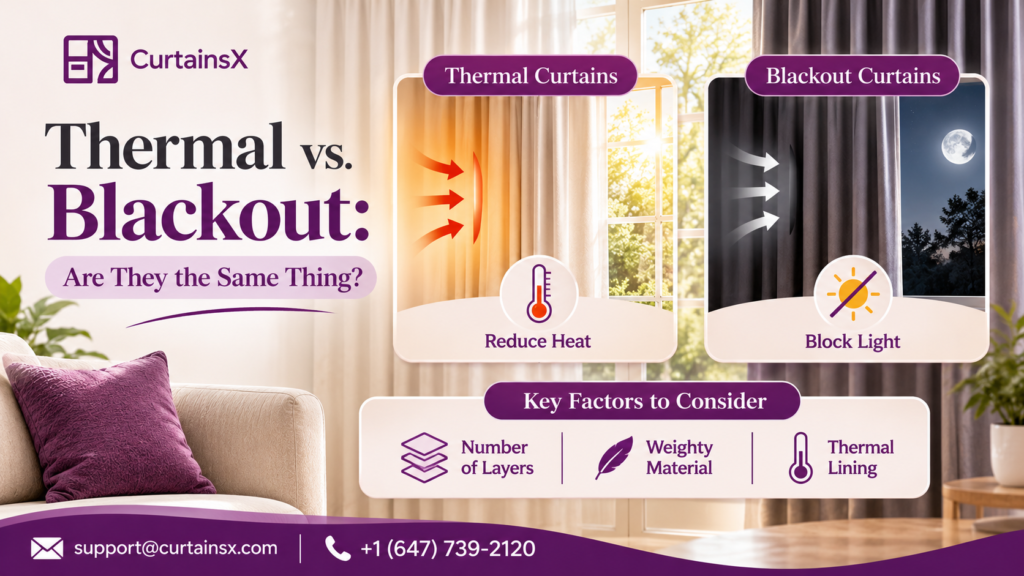
These terms mean different things. ‘Blackout’ refers to light reduction, whilst ‘thermal’ refers to heat reduction. Sometimes these two can be combined in a thick, multi-layered curtain, meaning you can purchase ‘thermal blackout’ curtain pairs. However, a thin coated blackout curtain may not be very effective at reducing heat, and a light coloured thermal curtain can allow a large amount of light through.
To decide whether to choose thermal or blackout curtains, it is important to consider 3 things: number of layers, weighty material, and if it has thermal lining. We offer standard, blackout and thermal linings. Find out what they can do in our buying guide.
Will Thermal Curtains Help In Cold Winters in Canada?
To some extent. By closing your curtains, you create a barrier of fabric and air between you and the cold outside. Closing drapes in the evening can reduce heat loss in a room by approximately 10%, however, hanging them close to the window and sealing on the sides and bottom of the curtains can improve this figure. These numbers are ideal figures, as depending on the material, fit and window, results can vary.
However, they aren’t very effective at reducing air leakage. Most window treatments aren’t very effective at reducing air leakage, so if you can feel a draught coming in, seal the window first. Thermal curtains can therefore be a useful element in improving efficiency, but cannot be relied upon to fully replace good quality windows and weather stripping.
To get the most benefit from thermal curtains in the winter, on sunny days, open south facing windows to allow free warming. However, be sure to close all windows at dusk. Be careful with closing tight curtains on cold windows, as moisture can become trapped. Make sure to open them regularly to allow fresh air to get to the glass.
Heavy fabrics such as velvet give curtains extra body for cold rooms. You can see the ATF collection velvet curtains at CurtainsX and check the lining options before you order.
Do Curtains Keep Heat Out in Summer?
Yes, if closed at the right time. To reduce heat in south and west facing windows in the summer, it is best to close the curtains in the middle of the day before the room gets too warm. Colour and backing matter too. Consumer Reports reports Department of Energy findings that medium coloured drapes with a white plastic backing can reduce heat gains by around a third, compared to a thin open weave material, which won’t be as effective.
To get the best results from your curtains to reduce summer heat, close them early, close to the window, allow them to reach the floor and have the middle panelling overlap.
Daytime Privacy and Sound Dampening
Privacy and noise reduction are often expected to be provided by curtains, however, it is important to understand what the realistic possibilities are.
Privacy Without Losing Daylight
Windows on street level can be tricky to manage. You may want light in the room, but don’t want people outside to be able to see inside. Depending on the time of day, privacy can be different. In the daytime, there is more light outside, so sheer materials can give you privacy. However, in the evening, with lighting switched on, sheer materials will make the room look like a stage.
Layering curtains will give a good balance. A light filter on an inner pole during the day, and lined curtains on an outer pole in the evenings. Other options could be café style curtains, to allow light into the room above eye level. Or tightly woven light filter materials to obscure detail. If you are looking for the best privacy curtains for street level windows, weave and weight are more important than colour.
How Much Noise Can Curtains Reduce?
Less than most marketing suggests. In independent tests of heavy, multi-layer curtains, Bob Vila’s testers measured reductions of around 6 decibels for one tested set. Other tests found top rated curtains can reduce noise by up to around 10db. Some acoustic experts suggest that average noise reduction from standard heavy curtains is only between 1-5db. A 10db reduction means the noise sounds half as loud, however, it will not completely eliminate noise from traffic. Low rumbling noises will still be heard clearly.
The best results come from heavy, thick materials, plenty of width, reaching to the floor and being fitted close to the wall. Curtains also absorb echoes within the room, creating a calmer atmosphere. Overall, rather than completely silencing noise, it is more accurate to say that they soften noise. To reduce noise from a very noisy street, firstly make sure to seal the window and then add curtains.
How to Choose: Match the Features to the Job
| Your goal | What to look for | What to skip |
|---|---|---|
| A dark bedroom | Blackout lining, wide rod, overlapping panels | Thin sheers on their own |
| Cold winters | Multi-layer or thermal lining, floor length, hung close to the window | Short, lightweight fabric |
| Hot, sunny rooms | Light-coloured backing, tight weave, closed at midday | Thin, dark single layers |
| Street-level privacy | A sheer layer plus a lined curtain | Sheers only |
| A quieter room | Heavy, dense fabric, generous width | Thin, lightweight panels |
Once you know the job, compare fabrics and sizes. You can browse the CurtainsX curtains collection, including the premium curtains and luxury European curtains, then match your measurements to the sizes listed on each page. If you are unsure about the right length, read how long curtains should be before you order.
Common Mistakes to Avoid
- Assuming every blackout curtain is also thermal, or the other way around
- Buying curtains that are too narrow, so light and drafts slip past the edges
- Fitting the pole directly into the window frame (should be higher and wider)
- Leaving curtains in the same position all day, every day
- Just using sheer curtains for privacy at night
- Expecting them to act as a complete replacement for sealing windows or reducing noise.
Common Questions
Which is better, blackout or thermal?
It depends on what you want! Blackout is best for complete darkness in bedrooms. Thermal is best for cold windows. If you want both, look for thick multi-layered curtains with thermal lining.
Can one curtain do everything? To an extent! A lined heavy curtain with a sheer layer will reduce light, privacy and some heat. However, you will get better results with correctly fitting curtains.
Will light blocking curtains make my room feel dark all day? Only if you leave them closed. Open them in the morning and close them when you need darkness or insulation.
How do I clean heavy light blocking curtains? See care instructions. Gently vacuum with a brush attachment. For deep cleaning, dry cleaning is best, especially for heavy / lined.
Final Thoughts
The best light blocking curtains to choose depend on what you want! To create a dark room for sleeping, multiple layers for privacy, heat reduction in cold winters and closure at midday in hot summers. Ensure you have the right materials, lining, pole position and times of day that you are using them for to get maximum saving and comfort. Once you know what you want, visit CurtainsX and check out our full range!