


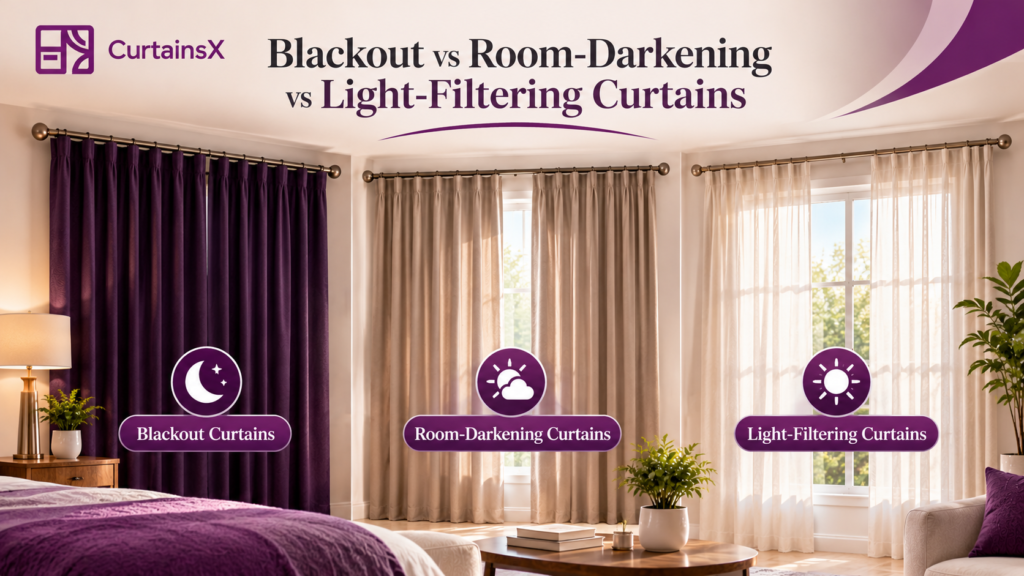
Light filtering, room darkening and blackout are 3 terms commonly used in curtain shops. Despite sounding similar, these curtains behave very differently. Choosing the wrong curtain could lead to a brightly lit bedroom in the early hours of the morning, or an overly dark living room during the day.
We’ve put together this guide to help you understand which is best to use in different rooms (blackout, room darkening or light filtering). This guide is part of our larger Light, Privacy & Energy Guide to assist you with sleeping better, lowering energy costs etc.
The Quick Comparison
| Light-filtering | Room-darkening | Blackout | |
|---|---|---|---|
| Daylight through the fabric | A good share, softly diffused | Little, a soft glow | Almost none |
| Commonly quoted light blocked | Roughly 40 to 70% | Roughly 80 to 95% | 99 to 100% |
| Daytime privacy | Good | Very good | Excellent |
| Privacy at night with lights on | Poor | Good | Excellent |
| Best for | Living and dining rooms | Home offices, nurseries, TV rooms | Bedrooms, media rooms, day sleepers |
Note that these percentages are approximate. Different brands will measure and describe them differently. ‘room-darkening’ in one brand may be classed as ‘blackout’ in another brand. However, depending on how the curtain has been constructed will affect how effective it is. We’ve explained how below.
Light Filtering
These curtains are made from lightweight, loosely woven materials, such as sheer, voile and linen style. This allows a nice amount of natural light to filter through the curtains meaning the room is bright with a soft feel. From outside, little shape can be seen and therefore a reasonable level of privacy is achieved.
However, when the lights are turned on in the evening, quite a lot of light will come through and you may get shadows from people outside. These types of curtains will not help you get good sleep, or save much heat.
This is best to use in living rooms, dining rooms and any other areas in which you want more light during the day. For bright rooms, such as south facing windows, light filtering in just one layer will work best in combination with a thick curtain.
Room Darkening
A thicker weave, tightly structured weave, or lined curtains can be used to reduce the amount of light coming into the room. There is a nice dark and relaxing feel to the room, but a gentle light will still filter through. When room darkening material is held up to a window, it is normally possible to tell that it is daylight outside.
This is a great compromise. Room darkening can be great to reduce glare from screens in home offices, or in nurseries. It can be used in TV rooms and bedrooms, as you will get good sleep with some gentle light.
However, there will still be a small amount of light left in. If you are a light sleeper, a night worker, or live next to a very bright street light, you may find room darkening curtains not dark enough.
Blackout
Thick backings/coverings can be added to make this curtain completely block light. When this curtain is held to a window, very little light will be visible. Blackout curtains are best for getting complete darkness in a room. This means bedrooms, media rooms, nurseries with strict nap schedules and day nappers.
Even blackout curtains won’t create 100% darkness if there is light leaking in at the sides. As a result, many people ask if blackout curtains really block all the light. Using a wide pole, lots of fullness and panel overlap can increase the blackout effect in the room. However, blackout refers to blocking light and not saving heat. If you want to save heat in the room, it is a good idea to read up on thermal vs blackout curtains. Although there is overlap in these types of curtains, they are not the same.
If you’d like blackout effect in a soft linen style, take a look at our linen effect blackout curtains.
Blackout vs Room Darkening
The main difference between room darkening and blackout curtains is how little light remains in. Room darkening has most of the light blocked, whereas blackout curtains have almost all of the light blocked. From this difference, we can see that blackout curtains will create a different effect in the room, cost more, and allow better sleep.
Given that there are many variations in naming in these curtains, it is best not to rely on the names alone. Instead you can run a quick test at home or using a sample:
- Hold a sample in front of a light source (or use your phone torch in a dark room).
- Look at the other side.
- If you can see very little or nothing, it is blackout. If you can see clear light, it is room darkening.
- Check for light on the seams, hem and top of the curtain as this is a common place for light to show through.
How the curtain has been made will also give clues. Blackouts will generally have thick backings, coverings or additional layers. Room darkening curtains will have thick weaves, or simply no lining. Thicker weaves (such as velvets) will block more light than thin weaves. Adding a lining will also increase the amount of light blocked. Take a look at our velvet range at ATF. We have a large variety of linings to choose from.
Which to pick?
Bedroom: Blackout curtains (especially if you are light sensitive). Even with your eyes shut, light can cause problems while trying to sleep. To get good sleep, it is best to have a dark room.
Nursery: Blackout curtains (to allow naps), or room darkening (if you would like a little light for night feeds).
Living room: Light filtering. For TV/evening time, lined or room darkening curtains can be used.
Home Office: Room darkening or light filtering, depending on how much glare there is on your screen.
Dining Room: Light filtering or lined, depending on how sunny it is and how much privacy you want.
Media Room: Blackout to avoid glare on the screen.
Can they be combined?
Yes! And it is often a good idea. By placing light filtering sheers on an inner pole, and lined/blackout curtains on an outer pole, you can allow natural light in during the day. However, when it gets dark, the heavy curtains can be drawn to block all light. This means you have all three levels of light in the same pair of curtains. You don’t need 3 pairs!
Alternatively, you can have a decorative curtain with a blackout backing. At CurtainsX we offer standard, blackout and thermal linings. Take a look at our buying guide to see how each can help.
Things to Consider
Width: If the curtains aren’t wide enough, light can come in at the sides. Choose curtains 1.5-2 times the width of your pole.
Pole Position: Place the pole slightly higher and wider than the window to reduce the amount of light coming in at the top and sides.
Length: Floor length curtains will block more light than sill length.
Samples: If possible, order a sample to see how they perform in your room.
Curtain care: Thicker lined curtains will generally require more gentle care. Check the care label.
Struggling to work out measurements? Take a look at our measuring guide for help.
FAQ
Are room darkening curtains dark enough for bedrooms? Many people will be fine with room darkening curtains in their bedroom. If you can get good sleep with a little light in, or you simply want to reduce glare, room darkening may be suitable. However if you are light sensitive, work nights or live near bright street lighting, blackout is best.
Does a darker colour mean more light will be blocked? No. Thin dark curtains can still let in light. The best way to block light is to have thick backings and thick materials, not dark colours.
Can I use blackout in my living room? Yes, but be sure to open them in the day. Many people choose blackout in their living room to watch TV in the evening, and place sheers next to them to allow light in during the day.
Summary
Depending on what you want the room to do, you can pick the best set of curtains. Light filtering provides gentle light, room darkening reduces glare and gives a relaxing feel. Blackout curtains provide complete darkness. If unsure, pairing sheer and lined curtains will give all 3 effects. To learn more about getting a good sleep, saving energy, privacy and reducing noise in your home, take a look at our Light, Privacy & Energy Guide. Otherwise, if ready to choose, take a look at our range of curtains at CurtainsX.